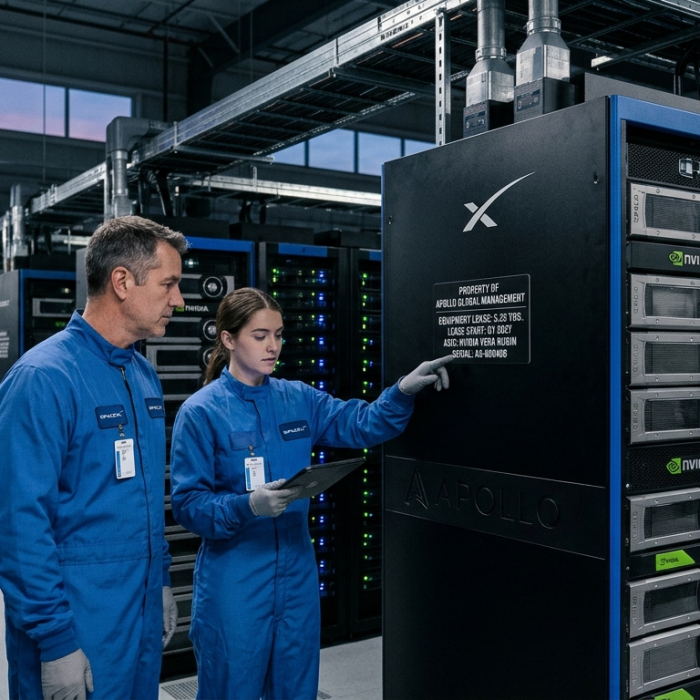


Artificial intelligence infrastructure may soon extend beyond traditional data centers on Earth. Google has reached an important milestone in this direction by successfully bringing its first experimental AI satellite online, demonstrating that machine learning hardware can operate in orbit and communicate with engineers on the ground.
The achievement is part of Google’s ambitious Project Suncatcher, a long-term research initiative exploring the possibility of building scalable AI computing infrastructure in space. The experimental satellite has already completed its first AI tasks, including generating a short poem using an onboard language model. While the demonstration may sound simple, it represents an important step toward understanding how future data centers could function beyond Earth’s atmosphere.
An AI Satellite Completes Its First Successful Tasks
Google’s prototype satellite was launched earlier in October aboard a SpaceX Falcon 9 rocket as part of a mission carrying more than 100 spacecraft. Following its launch, engineers spent approximately three weeks checking the satellite’s systems and preparing its computing hardware for operation.
The spacecraft carries four Google Tensor Processing Units (TPUs), specialized processors designed to handle machine learning workloads. However, its available power limits operation to one TPU at a time, with each operating session lasting approximately 20 minutes.
During its first successful communication test, engineers sent a prompt to Google’s Gemma 4 AI model installed onboard the satellite. The system responded by generating a short haiku inspired by its location in space.
Beyond creative tasks, engineers also tested the model’s ability to provide information about the satellite’s surrounding orbital conditions. Google confirmed that the spacecraft was operating normally following these initial experiments.
Why Google Wants to Build Data Centers in Space
The increasing demand for artificial intelligence is creating new infrastructure requirements. AI systems need significant computing power, electricity, and advanced cooling technologies to process growing volumes of information.
Traditional data centers face challenges involving electricity availability, cooling requirements, land usage, and operational costs. Google is investigating whether space-based infrastructure could offer an alternative approach over the longer term.
Satellites operating in suitable orbits could access consistent sunlight, creating opportunities for solar-powered computing systems. The company eventually envisions networks of satellites working together to handle larger AI workloads rather than relying exclusively on individual spacecraft.
However, making this concept commercially practical will require substantial engineering development and improvements in launch economics.
Testing AI Hardware Against Space Conditions
Operating advanced processors outside Earth’s atmosphere introduces several technical challenges. Radiation exposure and extreme temperature variations can affect electronic components and create reliability problems.
One particular concern is a phenomenon known as a bit flip. High-energy particles can change stored computer memory values, potentially corrupting information without immediately triggering conventional monitoring systems.
Google has already conducted radiation experiments on its TPU hardware using particle accelerator facilities on Earth. The current satellite mission allows engineers to compare those laboratory findings with actual conditions in orbit.
Thermal management is another major concern. Unlike conventional data centers, spacecraft cannot depend on ordinary airflow to cool processors. Engineers must develop specialized heat-transfer systems and radiators to prevent hardware from overheating.
The ongoing experiments will help Google understand how reliably its processors can execute AI workloads under these demanding conditions.
The Next Milestone: Connecting Satellites Together
Google’s ambitions extend beyond operating a single AI-powered spacecraft. If the current experiment delivers encouraging results, the company plans to launch two additional satellites in 2027.
These future spacecraft are expected to demonstrate higher power-generation capabilities and optical communication links between satellites.
Using laser-based connections, multiple spacecraft could exchange information and coordinate computing tasks. This approach could eventually support distributed AI processing across a network of orbiting satellites.
The concept distinguishes Project Suncatcher from approaches focused primarily on running individual AI workloads onboard separate spacecraft.
Space-Based AI Computing Is Still a Long-Term Vision
Google’s latest achievement demonstrates that running AI models in orbit is becoming technically achievable, but building commercially viable space data centers remains a much larger challenge.
Launch expenses, processor reliability, radiation protection, thermal management, and high-speed satellite communication all need further development. The availability of reusable heavy-lift rockets will also play an important role in determining whether large-scale orbital infrastructure can become economically realistic.
For now, Project Suncatcher remains an experimental initiative focused on gathering technical knowledge for the future.
Nevertheless, the successful AI response from Google’s satellite signals an interesting development in the evolution of computing infrastructure. As artificial intelligence continues to expand, the next generation of data centers may not be limited to facilities on the ground. Space could eventually become another destination for powering the world’s growing demand for intelligent computing.